Medical imaging

Dentistry

Ophthalmology

Analysis laboratory

Cardiology

Public sector

General practice

Gynaecology

Anaesthesiology










Pre-exam instructions
Patient follow-up
Sending documents
Making an appointment
Confirmation of appointments



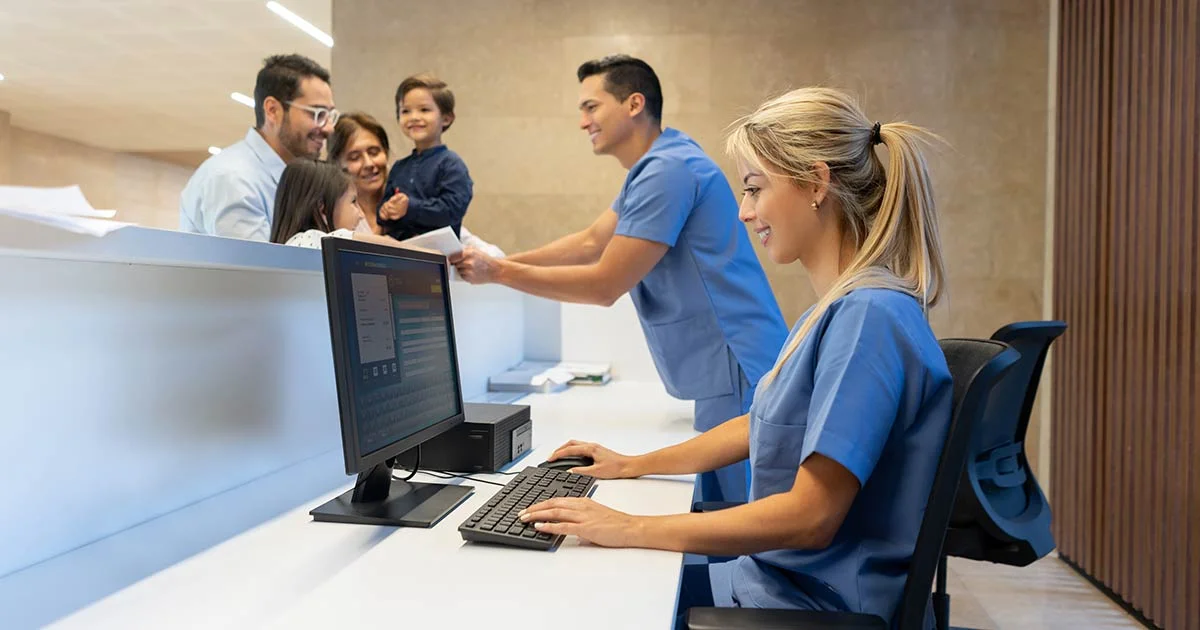



Will AI replace humans in healthcare? That is a false debate. Humans remain paramount, and AI is the tool that will allow them to be so more than ever. Discover how automating robotic tasks frees up time for empathy, judgement and care.
The healthcare sector is at a crossroads. On one side, an unprecedented wave of technological innovation, led by artificial intelligence, promises to automate, optimise and revolutionise entire areas of care organisation. On the other, a fundamental, unchanging truth that is the very essence of medicine: in the end, caring is a profoundly human act. It is an encounter between a person who is suffering or worried, and another who listens, understands and supports.
This tension between technology and humanity raises an essential question, a legitimate fear that holds many professionals back: by integrating AI into our practices and our hospitals, do we not risk losing what makes our profession valuable? Are we not dehumanising care?
The answer, paradoxical as it may be, is a resounding no. Not only does AI not threaten the place of humans, it is becoming their best ally in preserving and strengthening it. Because the real threat to the humanity of care is not the machine, it is the exhaustion of humans. It is the administrative overload, the organisational stress and the "robotisation" of tasks that prevent caregivers and their teams from doing what they do best: being human.
This article is an in-depth exploration of this conviction: humans remain paramount for healthcare services, and AI is the tool that will allow them to once again occupy the central place that is rightfully theirs.
To understand how AI can re-humanise care, we must first look unflinchingly at how the current system "dehumanises" its own people.
The role of a medical secretary should be one of communication, coordination and empathy. In reality, it is often reduced to a succession of mechanical and repetitive tasks:
This work, by its nature, is robotic. It wears down energy and motivation, leaving little room for genuine human interaction.
The doctor or nurse, for their part, sees their care time constantly chopped up by administrative interruptions. A question about a schedule, a call to validate, a document to sign... Each interruption breaks the bubble of concentration and listening so necessary for a quality consultation. The caregiver is forced to think "logistics" at the very moment they should be thinking "clinical".
For the patient, this overload translates into a degraded experience:
The conclusion is clear: administrative and organisational overload forces humans to behave like inefficient automatons. It is this system that must change.
Artificial intelligence is not an "intelligence" in the human sense. It is an ultra-high-performance automation engine. Its strength is being able to execute logical, repetitive and standardised tasks with superhuman speed and reliability. And that is precisely what we need.
The principle of a solution like Tennor is not to replace humans, but to create an intelligent division of labour:
By taking on 80% of the tasks that "robotised" the secretariat (appointment booking, reminders, frequently asked questions...), AI acts as a massive cognitive and operational relief.
This freed-up time and energy are not a void. They are a reclaimed space for the human.
AI does not eliminate human work, it purifies it. It strips away everything that is not essential, allowing people to concentrate on their true added value.
The most powerful vision is not AI or humans, but AI and humans working in perfect synergy. That is the principle of the hybrid model, at the heart of the Tennor solution.
AI is positioned on the front line to welcome 100% of calls. It acts as an expert triage system, capable of analysing each request in a few seconds.
Emergency management is an area where this collaboration is particularly powerful.
Case study: A patient calls at 19h, after closing time. They describe symptoms that could correspond to a stroke. Tennor's AI detects the keywords, interrupts its script, and delivers a safety message: "The symptoms you are describing require immediate attention. Please call 15." In parallel, it can send an informational (non-urgent) notification to the doctor. The AI has played its role as a safety net, where previously there was only an answering machine.
The arrival of AI is also an opportunity to upskill human teams. The secretary's role evolves:
Humans remain paramount, not only for handling exceptions, but also for training, supervising and continuously improving the AI.
Far from creating distance, a well-used AI can paradoxically strengthen the patient-practice bond.
By managing logistics flawlessly, AI creates a serene and reliable environment where the human relationship between patient and caregiver can flourish without being hampered by organizational issues.
1. If AI handles 80% of calls, won't the medical secretary role disappear?
No, it will transform and be enhanced. It's a similar evolution to what the accounting profession experienced with the arrival of software. Accountants no longer spend their time doing sums; they analyze, advise, and strategize. Tomorrow's medical secretary will no longer be a "switchboard operator," but a care pathway coordinator, a reception quality manager, and an AI supervisor. These are more complex, more interesting, and more essential tasks.
2. How can we ensure AI doesn't "block" a patient who absolutely needs to speak to a human?
Because it is programmed never to do so. An ethical and well-designed AI like Tennor has off-ramps at every step. If the patient says "I want to speak to someone," if the AI doesn't understand, or if it detects distress, its instruction is always the same: transfer to a human. The goal is not to trap the patient in a technological labyrinth, but to serve them as efficiently as possible.
3. Warmth, a smile, kindness... AI can never replace that. Isn't that the most important thing in reception?
You are absolutely right. And that's precisely why AI is necessary. Because a human secretary, even the kindest in the world, cannot smile on the phone if they are managing three emergencies and their line is saturated. AI is not meant to replace that smile. Its purpose is to create the conditions for that smile to exist. By absorbing stress and overload, it allows the human team to dedicate themselves to what only they can offer: genuine human warmth.
4. If humans only intervene in complex cases, won't they only be faced with stressful situations?
They will be faced with situations that require their expertise, which is the core of their job. But they will do so in a radically different context. They will have the time and the mental availability to manage these cases, one by one, without interruption. Managing a difficult situation is much less stressful when you can dedicate yourself fully to it. AI doesn't just filter calls, it filters stress.
5. Humans remain paramount, but how do we train teams for this new collaboration with AI?
This is a key step. Training shouldn't just be technical ("how to use the software"). It needs to be strategic. Teams need to be supported so they understand the philosophy of the hybrid model, so they see AI as an ally, and so they embrace their new role as supervisors and managers of complex cases. This is change management support that companies like Tennor fully integrate into their deployment process.
The idea that technology opposes humanity is an outdated view. In the healthcare sector, the true enemy of humans is the overload, repetition, and inefficiency that exhaust caregivers and degrade the relationship with patients.
Humans remain paramount for healthcare services, not despite AI, but thanks to it.
By acting as an organizational exoskeleton, conversational artificial intelligence takes on the burden of logistical and repetitive tasks. It does not replace the heart, brain, or soul of care. It protects and strengthens the framework that allows them to function serenely.
A solution like Tennor embodies this vision of technology serving humanity. By automating reception, it doesn't eliminate the secretary; it elevates their role. By streamlining the patient journey, it doesn't eliminate the doctor; it gives them back time for listening. Ultimately, AI may be the greatest opportunity we have for healthcare professionals to dedicate themselves anew, and fully, to their most essential mission: being human, for other humans.

+4M calls answered. Join partners who trust Tennor.