Medical imaging

Dentistry

Ophthalmology

Analysis laboratory

Cardiology

Public sector

General practice

Gynaecology

Anaesthesiology










Pre-exam instructions
Patient follow-up
Sending documents
Making an appointment
Confirmation of appointments







Does managing your medical centre feel like sailing by sight? Discover how managing your medical centre's activity with AI turns hunches into certainties. From real-time KPIs to flow analysis, take back strategic control of your organisation.
Running a modern medical centre is like being at the helm of a complex ship in the middle of a storm. The waves of patient demand are relentless, the winds of administrative pressure blow hard, and the currents of budget constraints are powerful. In this environment, sailing by sight, relying only on intuition and outdated monthly reports, is no longer an option. To stay on course and aim for excellence, you need precise, reliable, real-time navigation instruments. You need to be able to manage your medical centre's activity with AI.
Conversational artificial intelligence, well beyond its call-handling automation function, is becoming the control cockpit for healthcare centre managers. By capturing, structuring and analysing every patient interaction, platforms like Tennor turn telephone "noise" into strategic data. They provide a clear, dynamic view of activity, making it possible to move from reactive management to proactive steering.
This article is a complete guide for centre directors, healthcare managers and administrative leads. We will explore in depth how to manage your medical centre's activity with AI, which key performance indicators (KPIs) to track, how to interpret the data to make better decisions, and how this approach radically transforms performance and quality of care.
In many medical centres, management still relies on traditional methods that sorely lack visibility.
In the absence of reliable data, strategic decisions are often made on the basis of intuition, habit or the team's "gut feeling".
This approach, although often carried out sensibly, lacks the rigour needed to optimise an organisation as complex as a medical centre.
A conversational AI platform like Tennor radically changes the situation. By positioning itself as the single entry point for all communications, it becomes an information sensor of unmatched richness. Every call, every request, every interaction is captured, qualified, and turned into usable data.
When a patient calls, the AI does more than handle the conversation. It annotates every interaction with valuable metadata:
All this data, collected across thousands of interactions, feeds a management dashboard in real time.
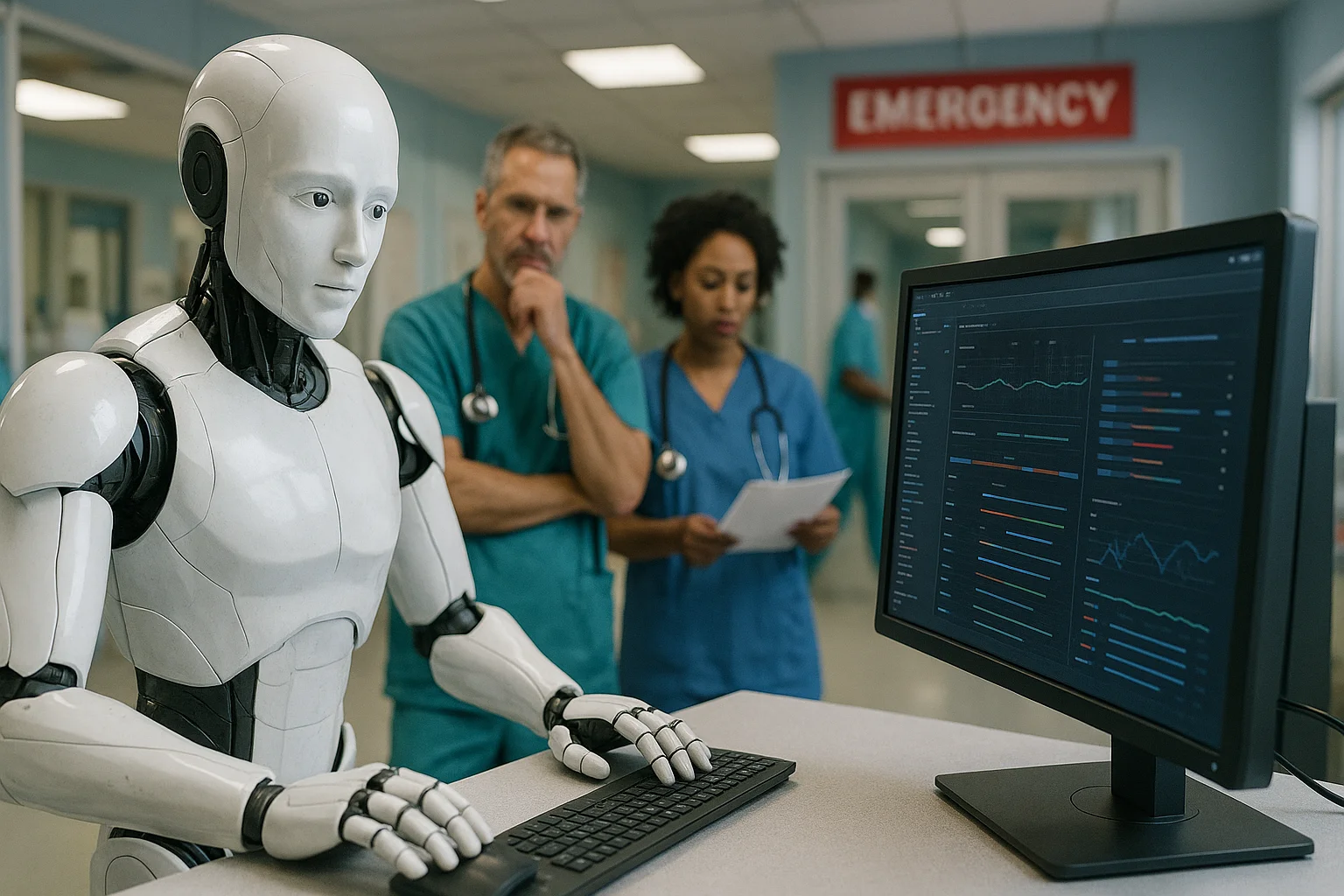
The dashboard provided by Tennor is designed for managers. It does not present raw data, but key performance indicators (KPIs) that are visual and easy to interpret. It is the cockpit that lets you manage your medical centre's activity with AI.
Here are the main indicators that AI lets you track, and how to use them to make strategic decisions.
- What it tells you: You instantly visualise your activity peaks. You can see whether the Monday morning peak is real and quantify its scale. - Strategic action: If you keep a human team as backup, you can adapt staff schedules to match resources to real demand, rather than to an estimate.
- What it tells you: This KPI should be 100%. It measures your centre's capacity to never miss a call again. The "automated handling rate" (generally around 80-90%) shows you the share of the workload managed without human intervention. - Strategic action: You directly measure the ROI of AI in terms of workload absorption.
- What it tells you: You know how long is needed to handle a standard request. - Strategic action: This data is crucial for sizing your teams if you have human backup.
- What it tells you: A pie chart shows you that, for example, 50% of calls concern appointment booking, 20% administrative questions, 15% cancellations, and so on. You can even filter by specialty. - Strategic action: It is a powerful diagnostic tool. If you see that 25% of calls to the radiology department ask "Do I need to fast?", it means your upstream communication is failing. You can then enrich the AI's knowledge base and update your information sheets.
- What it tells you: You track the effectiveness of your reminder strategy in real time. You can see whether the no-show rate falls after AI is introduced. - Strategic action: You can test different strategies. Is a reminder the day before (J-1) more effective than two days before (J-2)? Is SMS more effective than a voice call for a certain patient population? You can A/B test and optimise.
- What it tells you: The AI can calculate the delay between the call and the first available slot offered, by specialty. - Strategic action: This is a key indicator of access to care. If you see the lead time in dermatology skyrocket, it is an objective signal that you should consider opening more slots or recruiting.
- What it tells you: The percentage of requests that were fully resolved by AI without requiring a transfer or callback. This is an excellent indicator of your system's efficiency and intelligence. - Strategic Action: If this rate is low for a particular reason, it means that the AI workflow needs to be improved or that this reason consistently requires human intervention.
- What it tells you: It indicates the proportion of complex conversations or emergencies. - Strategic Action: Analyzing the reasons for transfer allows you to understand the limits of automation and better train your human teams to handle these specific cases.
Managing your medical center's activity with AI, it's about using this data to take action.
Case Study 1: Optimizing Schedules in Rheumatology
Case Study 2: Reducing no-shows in physiotherapy
1. How can we ensure that the data collected by AI is reliable and representative of reality?
Data reliability is absolute, as it is collected in a systematic and objective manner. Unlike human estimation, AI logs every interaction without bias. Every call is timestamped, and every reason is categorized by the same algorithm. Representativeness is guaranteed because AI is the entry point for 100% of communication flows. You therefore have an exhaustive view, not just a sample.
2. Won't my teams (doctors, secretaries) feel "monitored" by this constant tracking?
It's a matter of culture and communication. It's crucial to present the dashboard not as an individual monitoring tool, but as a collective management tool. The goal isn't to measure a secretary's performance, but to understand the performance of the system to improve it together. Data should be used to identify organizational problems and to empower teams by giving them the means to work better, not to control them.
3. I'm not a "data scientist." Will I be able to interpret these charts and KPIs?
Absolutely. A platform like Tennor is designed for healthcare managers, not data experts. The dashboards are visual, intuitive, and self-explanatory. They translate complex data into directly actionable insights. Furthermore, Tennor's teams support you by offering periodic analyses and helping you interpret the most relevant indicators for your objectives.
4. Beyond managing patient flow, can AI help me manage my center's financial performance?
Indirectly, yes, and very powerfully. By providing precise data on no-show rates, schedule fill rates, or the number of requests for high-value procedures, AI provides you with predictive indicators of your financial performance. You can correlate a drop in appointment confirmation rates with a future decrease in revenue and take proactive measures. It's a financial decision-making tool.
5. How can communication data help improve the clinical quality of care?
The link is direct. If an analysis of call reasons shows a large number of post-operative questions for a certain type of surgery, it may indicate that the information sheets given to patients are not clear enough. By improving this document, you reduce patient anxiety, the number of calls, and improve adherence to post-operative instructions, which has a direct impact on clinical outcomes. AI-driven management allows for identifying and correcting weaknesses in the care pathway.
Stop managing your medical center by looking in the rearview mirror. Managing your medical center's activity with AI, it's like having a real-time GPS that shows you where you are, where you're going, and the best way to get there.
By transforming every patient interaction into strategic data, a platform like Tennor offers unprecedented insight into your organization's operations. It allows you to replace guesswork with certainty, reactive measures with proactive strategies, and day-to-day management with true strategic guidance.
In an increasingly complex and competitive healthcare sector, the ability to make quick, informed decisions based on reliable data is no longer an advantage. It's a prerequisite for survival and excellence. AI is the tool that finally makes this smart management accessible to all healthcare centers.

+4M calls answered. Join partners who trust Tennor.