Medical imaging

Dentistry

Ophthalmology

Analysis laboratory

Cardiology

Public sector

General practice

Gynaecology

Anaesthesiology










Pre-exam instructions
Patient follow-up
Sending documents
Making an appointment
Confirmation of appointments



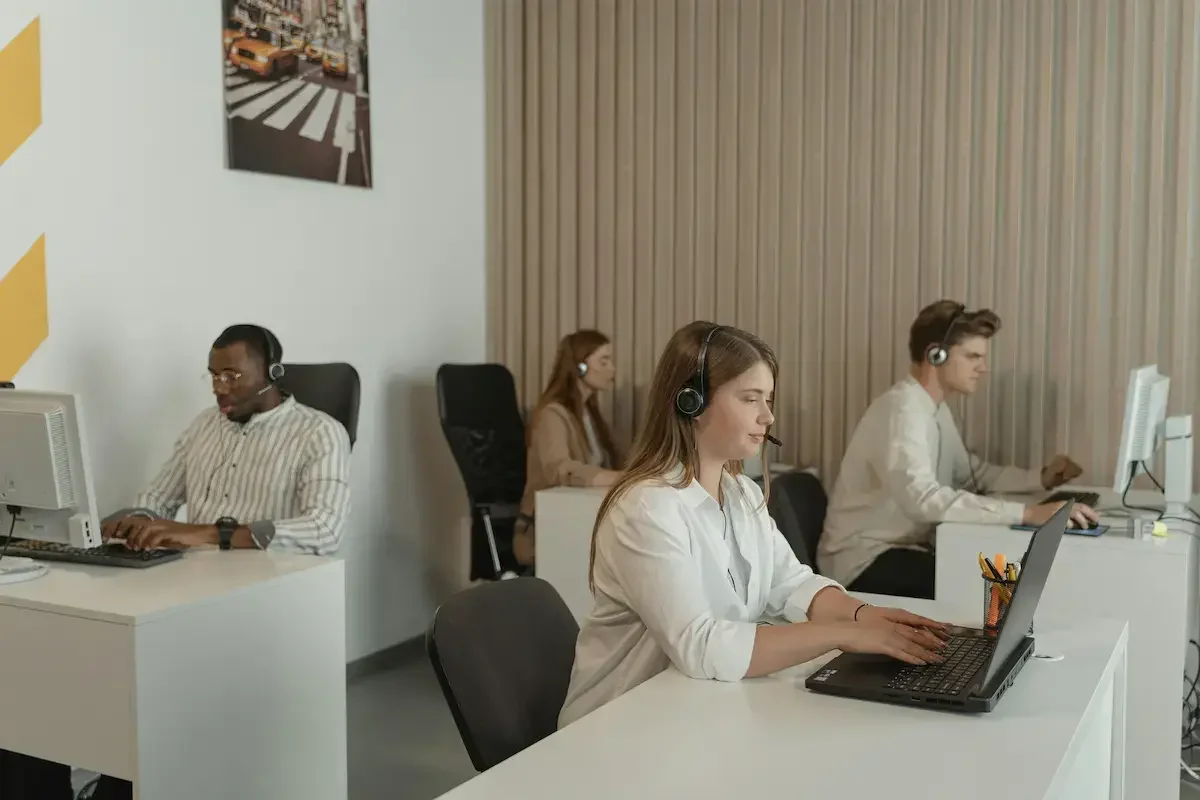



The Medical Call Center, once seen as a simple call centre, is undergoing a profound transformation. Faced with overloaded practices, increasingly complex care pathways and patients' growing expectations in terms of responsiveness and personalisation, traditional models are reaching their limits. The integration of Artificial Intelligence is opening a new era, transforming the Medical Call Center into a genuine strategic pillar, capable of offering 24/7 availability, optimised call-flow management and a patient experience that is both seamless and deeply human. Discover how this hybrid model is redefining the standards of medical reception.
The healthcare sector is constantly evolving, shaken by new requirements and major challenges. At the heart of this transformation, the initial point of contact between the patient and the care system - the Medical Call Center - has become a major issue. Far from being a simple telephone switchboard, it is the gateway, the first impression, and often the determining factor in patient satisfaction. Yet existing models, whether overstretched in-house secretariats or outsourced medical answering services with structural limitations, struggle to respond effectively to growing demand.
The good news? Artificial Intelligence is no longer a distant promise but a concrete reality, ready to revolutionise this field. By combining with human expertise, AI transforms the Medical Call Center into a hybrid, ultra-high-performance service, able to combine operational efficiency, unfailing availability and preserved humanity. This comprehensive guide explores the reasons behind this transformation, the concrete benefits of AI in medical reception, and how Tennor embodies this new era, placing the patient and care staff at the centre of innovation.
Historically, the Medical Call Center (often a simple secretariat or an outsourced call centre) has played a crucial role in organising care. It is the nerve centre where appointments are coordinated, vital information is passed on and urgent matters are handled. However, this essential link is now under unprecedented pressure that reveals its limitations.
Medical secretaries, whether in-house or in an outsourced answering service, face an ever-growing volume of calls. The repetition of the same tasks (simple appointment booking, cancellations, questions about opening hours), constant interruptions, and the emotional management of sometimes anxious or demanding patients lead to a state of chronic mental overload.
As we explored in the article "Reducing the Mental Load on Medical Secretaries: AI for Calmer Teams", this pressure has direct consequences:
The outsourced medical answering service was an attempt to respond to this overload. However, as detailed in "The End of the Outsourced Medical Answering Service? AI Is Establishing Itself as the Practice's New Assistant", this model often has its own limitations:
As for traditional Interactive Voice Response (IVR) systems, they offer a rigid solution that patients dislike. Their voice-menu tree structure is often perceived as impersonal and frustrating, unable to handle the complexity or spontaneity of a natural conversation.
Ultimately, these challenges result in an unsatisfactory patient experience:
These findings underline the urgency of a new approach for the Medical Call Center, an approach that can combine availability, efficiency and humanity.
The integration of Artificial Intelligence into the Medical Call Center is not a simple improvement; it is a genuine operational revolution. AI is not there to replace humans, but to augment their capabilities, relieve teams of repetitive tasks and offer unrivalled availability.
The first and most obvious advantage of AI is its ability to work tirelessly. An intelligent voice assistant is available 24 hours a day, 7 days a week, 365 days a year. It does not take breaks, never gets tired and does not go on holiday. This guarantees that no call is missed, whatever the hour or the day.
More importantly, AI can handle hundreds, even thousands of calls simultaneously. The very notion of an "engaged line" or a "queue" disappears completely. Every patient feels immediately taken care of, even during intense peak periods (such as Monday mornings). This capacity is humanly impossible to achieve and radically transforms the accessibility of healthcare services.
Diary management is one of the most time-consuming and complex tasks of a secretariat. AI excels in this area thanks to its multi-parameter matching algorithms, as we detailed in "Appointment Booking: How AI Outperforms Humans on Speed".
AI can:
This automation drastically reduces human error and frees up valuable time for staff.
An AI voice assistant is not a simple answering machine. It uses natural language processing (NLP) to understand and qualify the patient's intent.
AI does not make mistakes, does not get tired and does not get distracted. The information it communicates is always that which has been pre-recorded and validated by the practice. This guarantees perfectly consistent answers and reliable transmission of instructions, reducing misunderstandings and frustration.
The technological efficiency of AI is undeniable, but it does not replace the essence of the human relationship. The true strength of tomorrow's Medical Call Center lies in a hybrid model, where AI and humans work in synergy, each bringing their added value where they excel. This is what we have called the "Medical Answering Service and Artificial Intelligence: The Winning Duo for Your Healthcare Practice".
In this model, AI acts as the first line of defence, handling the vast majority of interactions. Humans, meanwhile, are positioned at the top of the skills pyramid.
This synergy delivers tangible benefits for the entire healthcare system:
Tennor is at the forefront of this revolution, offering a complete Medical Call Center solution based on this intelligent hybrid model.
At the heart of Tennor lies a latest-generation AI voice assistant, capable of:
Tennor does not offer an "all or nothing" AI. If the AI detects a situation beyond its capabilities, the call is automatically and transparently transferred to a network of qualified medical secretaries, based in France.
Tennor offers healthcare professionals a comprehensive dashboard to manage the activity of their Medical Call Center:
This data-driven management enables continuous improvement of reception and organisation.
Tennor offers a clear and predictable flat-rate subscription model, providing full visibility over costs, with no surprises linked to call volume. Beyond the economic aspect, Tennor takes an ethical approach by valuing human work and guaranteeing secure, GDPR-compliant management of health data.
Adopting an AI-augmented Medical Call Center generates benefits across the entire medical ecosystem.
The Medical Call Center is on the cusp of a new era. The challenges posed by overload, complexity and patient expectations call for a profound transformation. Artificial Intelligence is not a threat, but the most powerful solution to meet them.
By using AI to handle volume, speed and standardisation, and reserving human expertise for empathy, judgement and complexity, we create a winning duo. Tennor embodies this vision, offering a platform where technology amplifies humanity, where efficiency never comes at the expense of relationships, and where every patient benefits from fast, reliable and personalised reception.
Investing in a new-generation Medical Call Center means choosing a calmer, more efficient organisation, resolutely focused on the future, at the service of everyone's well-being.

+4M calls answered. Join partners who trust Tennor.